
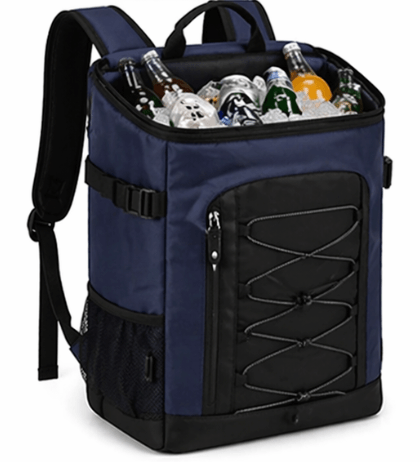
Cooler bag size is mostly a packing problem, not a product-page problem.
What matters is what you pack, how long it must stay cold, how much space ice takes, and how far you must carry it. Most buyers should choose the smallest bag that fits their real load plus ice, because oversized bags are heavier, more awkward, and they lose cold faster once you give that air space room to work. Manufacturers commonly overstate volume; a 20-liter bag usually offers only 14 to 16 liters of usable space once you account for dead air and thick insulation layers.
Start With the Payload, Not the Product Page
Choose cooler bag size by calculating what you will actually pack. Do not start with the can-count label and work backward. Rectangular meal prep containers, round water bottles, and thick ice blocks create unavoidable dead space inside a bag, and that dead space is where sizing mistakes start. Manufacturers estimate that only 70% to 80% of a soft cooler’s listed volume is actually usable for mixed food loads due to these awkward shapes.
For one person heading to an office, an 8-liter to 10-liter capacity is usually the baseline. Owners of the 9.2-liter Yeti Hopper Flip 8 frequently report it tightly fits one large glass meal-prep bowl, a 2-pound ice block, and one canned drink. That is useful because it is concrete, and because it shows how quickly a bag that sounds roomy on paper stops feeling roomy once the food is not shaped like cans.
Parents carrying sports snacks for two children or couples packing a half-day beach lunch generally require at least 15 to 18 liters to fit sandwich boxes alongside 500 mL water bottles.
Count Your Load First Checklist:
- Solo Lunch: 1 meal-prep container + 1 drink + 1 flat ice pack = 8-10 Liters
- Two-Person Outing: 2 sandwich boxes + 4 canned drinks + 2 ice packs = 15-18 Liters
- Family Half-Day (4 people): 4 lunch containers + 4-6 drinks + loose ice = 24-30 Liters
Why “24 Cans” Rarely Means 24 Cans Plus Food
Can capacity is marketing shorthand. It estimates standard-can storage, not a realistic mixed food-and-drink load. Brands test capacity by filling the empty bag entirely with 12-ounce (355 mL) aluminum cans, leaving absolutely zero room for ice or rigid food containers.
A cooler bag advertised as a “24-can” model usually holds approximately 14 to 18 liters. If you add the manufacturer-recommended ice, that same 24-can bag will only fit about 12 cans. Mixed loads cut that down again. Round beverage cans sitting next to square sandwich boxes create air gaps. Since air warms up quickly and transfers heat to the contents, you must fill these gaps with extra ice packs, which consumes even more of your listed capacit.
| Listed Marketing Capacity | Realistic Mixed Load Capacity (Food + Drinks + Ice) |
|---|---|
| 12-Can / 8-10 Liters | 1 meal, 1-2 drinks, 1 ice pack |
| 24-Can / 15-18 Liters | 2 meals, 4 drinks, 2 large ice blocks |
| 36-Can / 25-30 Liters | 4 meals, 6-8 drinks, loose ice |
Trip Length Changes the Size Math Faster Than Group Size
The United States Department of Agriculture (USDA) states that perishable food must remain at 40°F (4°C) or below. If the outside temperature exceeds 90°F (32°C), food becomes unsafe to eat in just one hour without proper cooling [Source: fsis.usda.gov/keep-food-cool-for-the-summer].
That changes the sizing math fast. Meeting these safety standards on longer trips requires dramatically more cooling medium. Industry guidelines recommend an ice-to-contents ratio of 2:1 for full-day trips in high heat [Source: szoneier.com/how-to-keep-a-cooler-bag-cold-for-longer]. This means two-thirds of your bag’s internal volume will be occupied by ice or gel packs.
If you are packing lunch for a two-hour commute to an air-conditioned office, you can use a 10-liter bag with a single flat gel pack. If you take that exact same food load to a hot beach for eight hours, you must size up to a 15-liter or 18-liter bag simply to hold the extra ice blocks required to maintain safe temperatures.
Measure the Spaces It Must Fit Into Before You Buy
This is the boring part, but it saves returns.
External dimensions dictate where a soft cooler can travel. Buyers frequently purchase a bag based on its 30-liter capacity, only to find it cannot squeeze behind a car seat or fit under a stroller.
If you plan to use the cooler bag as a secondary carry-on item for flights, it must fit airline sizing constraints. The International Air Transport Association (IATA) lists standard carry-on maximums around 55 x 40 x 20 cm (22 x 16 x 8 inches) [Source: trip.com/cabin-luggage-size-weight-guide]. However, if the bag must fit entirely under the seat as a personal item, it generally cannot exceed 33 x 16 x 43 cm (13 x 6 x 17 inches).
Measure These 4 Places Before Buying:
- Car Footwell: Measure the gap between the rear seat and the back of the front seat.
- Stroller Basket: Check the clearance height. Many baskets require bags under 10 inches tall.
- Airline Under-Seat: Ensure the bag depth is 8 inches or less.
- Office Fridge: Measure shelf depth. Wide tote coolers often prevent the fridge door from closing.
Filled Weight Is the Dealbreaker Most Buyers Miss
This is where a lot of otherwise sensible cooler choices go wrong.
The right cooler size is not just what fits your food. It is what you can comfortably carry once fully loaded. A cooler bag may hold the perfect volume but still be the wrong choice if it exceeds your lifting capacity.
High-performance soft coolers contain dense insulation that adds significant empty weight. The Titan PRO 36 Can Welded Cooler weighs 13 pounds (5.8 kg) entirely empty [Source: gearjunkie.com/best-soft-coolers]. RTIC’s 24-can Ultra-Tough Backpack Cooler weighs 5 pounds (2.2 kg) empty [Source: rticoutdoors.com/ultra-tough-backpack-cooler]. Those are not rounding-error numbers. They should change how you read the rest of the spec sheet, because once the empty bag is heavy, every extra liter has to justify itself, and a lot of shoppers never do that math until they are already committed to a shoulder strap setup that made sense on the screen and makes much less sense once ice is involved. When you add contents, weight escalates quickly. One liter of water or beverage weighs 1 kilogram (2.2 lbs). If you fill a 30-liter shoulder bag with 12 cans of beer, a 10-pound bag of loose ice, and the bag’s own empty weight, you will be carrying nearly 30 pounds on a single strap. That is the part people feel, literally, long before they care about listed capacity.
I would rather undersize slightly and pack tighter than carry extra empty cooler wall and insulation for no reason, even though I still have a bias toward bigger bags when I read product listings.
Bag Style Weight Recommendations:
- Under 10 lbs loaded: Hand-carry tote handles are usually enough.
- 10 to 20 lbs loaded: Padded shoulder strap required.
- Over 20 lbs loaded: Switch to a backpack cooler or a wheeled soft cooler to prevent shoulder strain.
Shape Beats Capacity When Comparing Tote, Box, and Backpack Styles
Equal internal capacity does not translate to equal usability. A 20-liter tote, a 20-liter box cooler, and a 20-liter backpack will pack entirely differently based on internal dimensions.
Internal height dictates whether bottles can stand upright. Standard 750mL wine bottles and 2-liter soda bottles require at least 13 inches of internal clearance [Source: berger-camping.com/dometic-ci-28-cool-box]. Box-style coolers often measure only 10 or 11 inches tall, forcing tall bottles to lie flat. Laying bottles horizontally eats up floor space and makes accessing food underneath them difficult.
Backpack coolers prioritize vertical space and narrow widths to keep the load close to your spine. For example, the RTIC Backpack Cooler offers nearly 13 inches of interior height but only 9.65 inches of internal width [Source: rticoutdoors.com/ultra-tough-backpack-cooler]. This shape easily swallows tall bottles and stacked cans but will not accommodate wide, flat pizza boxes or oversized family meal platters. Totes offer wider openings but often taper at the top, restricting how high you can stack rigid containers. I still lean toward box-style lunch coolers, even though backpack shapes carry better once the load gets heavy. Packing is simpler. Carrying is worse. On some of these welded models, the mouth is the real limit.
The Most Common Sizing Mistakes Buyers Make
Retail return data and outdoor gear forum complaints highlight several predictable errors buyers make when selecting cooler bags.
- Mistake: Buying based on maximum possible capacity.
Fix: A large cooler packed with small amounts of food leaves room for excessive air space, forcing the ice to work harder to maintain 40°F [Source: extension.umaine.edu/tips-for-cooler-food-safety]. Buy for your average daily use, not the one large party you throw every year. - Mistake: Forgetting the ice tax.
Fix: Always assume 30% to 50% of the bag’s volume will be dedicated to gel packs or loose ice, depending on trip length. - Mistake: Ignoring internal tapering.
Fix: Many soft coolers feature sloped walls. A bag that is 14 inches wide at the base may only be 10 inches wide at the zipper, preventing top-level packing. Look for square, box-style designs if you pack rigid lunch containers.
A 2-Minute Sizing Framework Before You Click Buy
For most buyers, the best cooler bag is the smallest one that fits your planned load, required ice, and real carry distance. Use this 4-step framework to narrow down your choices quickly.
- Identify the primary use case: Are you packing daily lunches or weekend beach drinks?
- Determine the ice requirement: Under 4 hours needs one ice pack (takes up 10% space). Over 6 hours in the sun needs a 2:1 ice ratio (takes up 66% space).
- Check your container footprints: Measure your widest meal prep box or tallest bottle. Verify the bag’s internal dimensions exceed these numbers.
- Select the carry style by weight: If your calculated load (food + ice + empty bag) exceeds 20 pounds, filter your search to backpack coolers or wheeled options only.
Best Size By Scenario:
- Solo Office Commute: 8 to 10 Liters (Tote or small box)
- 2-Person Picnic / Short Hike: 15 to 18 Liters (Shoulder strap or small backpack)
- Family Beach Day (4 people): 25 to 30 Liters (Backpack or wheeled soft cooler)
FAQ
What size cooler bag do I need for a day trip?
For a single person on a full-day trip, a 15-liter cooler bag provides enough room for two meals, drinks, and the heavy ice blocks needed to maintain safe temperatures all day.
How much space should I leave for ice packs or ice?
For short indoor commutes, ice packs require 10% to 20% of your bag. For full-day outdoor trips in high heat, you should reserve up to 66% of the internal volume for ice (a 2:1 ratio). This is why a bag that feels oversized for work lunch can feel barely adequate at the beach. Same food, different cooling burden.
Is a 24-can cooler bag big enough for food and drinks?
Usually not once you add ice. A 24-can cooler bag (usually 15-18 liters) fits approximately 12 cans once you add ice, and for mixed loads it comfortably holds lunch for two people alongside two drinks and two ice packs.
Are backpack coolers smaller than regular cooler bags with the same listed capacity?
Not necessarily. Internal capacity is the same, but backpack coolers are narrower and taller, which is great for tall water bottles and not great for wide, flat containers.
What cooler bag size works best for a family picnic?
A family of four requires a 25-liter to 30-liter cooler bag to fit four lunches, multiple drinks, and adequate ice without crushing the contents.
Should I choose by liters, can count, or dimensions?
Choose by internal dimensions first. Then use liters to gauge total volume. Ignore can-count labels, because they assume no ice or food is packed, and that shortcut causes a lot of bad buying decisions.