
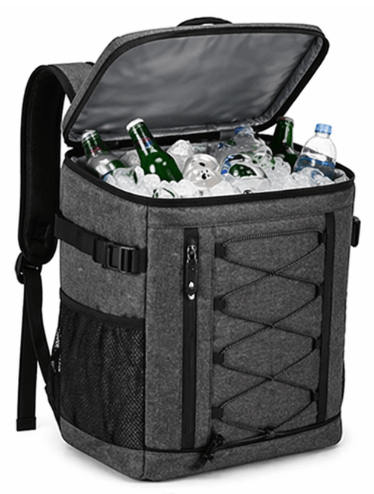
TL;DR
Foam provides most cooler bag insulation by slowing conduction, foil mainly reflects radiant heat, and fabric mostly affects durability and leakage control. Real-world performance depends heavily on foam density—typically ranging from 3mm in cheap totes to 15mm in premium soft coolers—as well as closure quality and how tightly the contents fill the bag.
The real job of a cooler bag: slowing three kinds of heat
Cooler bags do not actively generate cold. They are passive thermal control systems built to preserve an already low temperature by slowing the rate at which heat enters the bag.
When you place ice packs inside a bag, the internal temperature drops. The insulation then works as a physical obstacle course against external thermal energy.
Insulated bags have to deal with three forms of heat transfer. Conduction happens through direct physical contact, like a cooler bag sitting on hot asphalt or a warm car seat. Convection is moving air, which shows up when warm wind hits the bag or hot air slips in through a poorly sealed zipper. Radiation is heat moving by electromagnetic waves, most obviously direct sunlight at the beach.
That is why manufacturers build multi-layer stacks instead of a single shell. A bare fabric bag has effectively no thermal resistance. Add layered insulation and cooling duration can extend by a factor of two to four compared to an uninsulated container.
Heat Transfer Control in a Cooler Bag
| Heat Type | Where It Happens | Material That Helps Most |
|---|---|---|
| Conduction | Base resting on hot sand or floors | High-density closed-cell foam |
| Convection | Zippers, seams, and fabric exposure | Airtight zippers and high-denier outer shell |
| Radiation | Direct sunlight hitting the bag | Reflective aluminum foil lining |
The bottom panel usually tells on the bag first.
Foam is the main insulator; foil is a supporting layer
In most cooler bags, foam is the layer doing the real insulation work, while foil mainly helps with radiant heat. Foam traps millions of microscopic air bubbles and slows heat flow. That is the core of the system.
Manufacturers mostly work with two broad foam categories. Open-cell foam is cheap and light, but its internal structure absorbs moisture. Once condensation gets into it, the material starts acting like a sponge, thermal resistance drops, and mold becomes part of the conversation. Closed-cell foam, including Polyethylene (PE), Ethylene-Vinyl Acetate (EVA), and Polyurethane (PU), uses sealed pockets instead. That keeps water out and holds insulation value more consistently. High-quality closed-cell PU or cross-linked PE (XPE) foams can offer an R-value of up to R-6.0 per inch, whereas standard Expanded Polyethylene (EPE) foam provides an R-value closer to 3.6 to 4.2 per inch.
“Foil-lined” gets a lot of marketing mileage. Thin aluminum or metallized polyethylene films can reflect 94% to 97% of radiant heat, which matters in direct sun, and they also give you a wipeable, food-safe interior. But foil does very little against conductive heat from the ground. If the bag is leaning on foil and only has a 2mm open-cell foam core, it is not holding ice for very long.
Insulation Material Roles
| Layer | Primary Material Options | Main Thermal Function |
|---|---|---|
| Insulation Core | PE, EVA, or PU closed-cell foam | Traps air to slow conductive heat transfer |
| Inner Lining | Aluminum foil, metallized PE film | Reflects radiant heat, prevents liquid absorption |
| Outer Shell | 600D/900D Polyester, Nylon | Blocks wind-driven convective heat |
Thickness beats hype: what to inspect beyond “insulated”
The most useful buying signal is usually foam thickness and coverage, not labels like “thermal” or “premium insulated.” Every additional millimeter of closed-cell foam mathematically reduces thermal exchange.
In manufacturing terms, cooler bag insulation tends to fall into three buckets. Thin is 3mm to 6mm, which is fine for short trips like carrying a lunch box to a refrigerated office. Medium is 6mm to 10mm, better suited to grocery transport and everyday errands. Thick is 10mm to 15mm, which is where catering bags, camping soft coolers, and day-trip units start to live.
Then check where the foam actually is. Plenty of bags pad the side walls, then get stingy with the lid or use a thinner bottom panel even though that bottom panel is where conductive heat is often worst.
5 Things to Inspect Before Buying:
- Pinch the walls first. Expect at least 8mm for outdoor use.
- The bottom should feel as thick, or thicker, than the side walls.
- Press the lid too. Make sure the foam core continues through the lid.
- Inside, look for smooth, heat-welded seams rather than visible thread stitches in the main compartment.
- Test compression if you can: High-density EVA foam will resist squeezing and bounce back immediately, while low-grade PE foam compresses easily.
Fabric matters less thermally—but more than buyers think
Outer and inner fabrics add only a marginal amount to a cooler bag’s R-value. Their real job is protecting the foam core from abrasion, water intrusion, and moving air.
For the exterior, 600D and 900D polyester give you dimensional stability and abrasion resistance. High-denier nylon has better tensile strength and tends to show up in premium retail soft coolers. These fabrics help block wind-driven convective loss, but they do not rescue a weak insulation core.
Inside the bag, the lining decides whether the thing stays sanitary and whether melted ice stays where it belongs. Low-cost bags usually use Polyethylene Vinyl Acetate (PEVA), which is food-safe and water-resistant. The problem is assembly: if that PEVA liner is sewn on standard machines, the needle holes become leak paths. Melted ice water will pass through stitched seams. Premium soft coolers use Thermoplastic Polyurethane (TPU), which is non-porous, naturally free of phthalates, and compatible with high-frequency radio (RF) welding. RF welding fuses the TPU layers at a molecular level and creates a 100% leakproof interior with zero needle holes.
Common Cooler Bag Fabrics
| Material | Location | Main Purpose | Tradeoffs |
|---|---|---|---|
| Polyester (600D/900D) | Outer Shell | Abrasion resistance, structure | Heavier than nylon, absorbs external moisture if uncoated |
| Nylon | Outer Shell | High tensile strength, flexibility | More expensive than polyester |
| PEVA | Inner Liner | Basic waterproofing, food safety | Cannot be reliably heat-welded; prone to stitching leaks |
| TPU | Inner Liner | 100% leakproof RF welding, mold resistance | Highest material cost, stiffer texture |
The stitching tells on cheap bags pretty fast.
Where cold retention is usually lost first: zippers, seams, and lid gaps
Most cooler bags do not fail because the wall insulation was a little too thin. They fail at the openings.
A bag can spec 15mm closed-cell EVA foam and still bleed cold through the coil. Standard zippers leave continuous gaps between teeth, so warm air keeps finding a way in and cold air keeps settling out, and once you start opening and closing the bag in a hot environment the insulation number on the hang tag matters a lot less than buyers want it to. Premium soft coolers try to fix that with airtight, waterproof zippers similar to the ones used on dry suits, but those zippers are not carefree hardware. Users consistently report that waterproof zippers on brands like RTIC become extremely difficult to open or completely detach from their tracks if not regularly treated with silicone zipper lubricant, which is one of those maintenance details people ignore until the bag gets weird and then suddenly it is the only thing they care about. I still tend to shop by wall thickness first, even though this is usually the section that decides whether a bag actually performs.
Empty air inside the bag is the other quiet problem. A cooler bag filled to 50% capacity makes the ice cool a large volume of ambient air. Soft bags that lack structural rigidity can deform when underfilled, and those folds can pop open magnetic closures or put strain on the zipper track.
Common Thermal Failure Points:
- Stitched corners: Liquid water pools at the bottom and leaks through needle holes, reducing internal ice mass.
- Standard zipper tracks: constant convective air exchange.
- Fold-top gaps: Roll-top bags that are only folded once or twice allow radiant heat to penetrate the uninsulated top section.
- Uninsulated lids: Thin fabric flaps bridging thick foam walls act as a thermal bridge.
And once the zipper track starts fighting you, the rest of the bag tends to follow.
Material stacks that fit different jobs
There is no single insulation build that fits every use case. The right stack depends on duration, heat exposure, and how much cold mass you are moving.
For a daily office commute, a 4-to-6 can micro-cooler usually needs only 3mm to 6mm of PE foam. Grocery totes are different: a 6mm EPE foam core, foil liner, and rigid base insert is usually enough because the trip is short and the contents already start cold. Beach days and weekend camping are the expensive cases. Those call for 10mm to 15mm of closed-cell PU or EVA foam, an RF-welded TPU inner liner, and a waterproof zipper.
Decision Matrix by Use Case
| Use Case | Typical Duration | Recommended Insulation Build | Ideal Capacity |
|---|---|---|---|
| Office Lunch | 2-4 hours | 3-5mm PE foam, standard zipper, PEVA liner | 4-6 cans |
| Grocery Transport | 1-2 hours | 6-8mm EPE foam, foil lining, structured base | 20-30 liters |
| Day Trip / Beach | 8-12 hours | 10mm EVA foam, welded TPU liner, coated zipper | 12-18 cans |
| Camping / Multi-day | 24-48 hours | 15mm closed-cell PU foam, airtight zipper, TPU shell | 20-35 liters |
That rigid base insert matters more than it sounds.
A fair way to compare cooler bags before you buy
If you actually want to compare two cooler bags, use a repeatable ice test instead of trusting whatever the packaging says. Ice retention numbers swing all over the place if the test conditions do.
A decent home version is simple enough. Keep both coolers in a room-temperature space at around 72°F overnight so neither one starts pre-heated or pre-chilled. Fill each cooler exactly halfway with standard cubed ice. Skip beverages and extra water, because changing the thermal mass changes the result. Then put both bags in the same warm but controlled environment, like a shaded patio or garage at 85°F to 90°F.
Check them on a schedule. Open each one for exactly 15 seconds every 12 hours, close them securely, and stop when the last solid ice turns to water.
Standardized Comparison Protocol:
- Equalize: Store empty bags at room temperature for 12 hours.
- Load: Fill bags to exactly 50% capacity with cubed ice from the same source.
- Position: Place side-by-side in a shaded, warm environment.
- Monitor: Open for 15 seconds every 12 hours.
- Measure: Record the hour count when 100% of the ice has converted to water.
Shade is doing more work in these tests than people admit.
When a soft cooler is enough—and when it isn’t
A soft cooler is enough for short trips and moderate heat. Long durations or brutal exposure are where hard coolers still pull away.
At the top end, soft coolers with 15mm EVA foam and airtight zippers can reach roughly 48 to 72 hours of ice retention under ideal conditions. In actual use, especially in 85°F summer heat with frequent openings for drinks and food, reports from camping forums put premium soft coolers more in the 24 to 36 hours range.
Hard rotomolded coolers have a structural advantage that soft bags just do not. Their walls often use two to three inches of pressure-injected polyurethane foam, and the lids seal with heavy rubber gaskets. If the trip runs past two days, or the cooler is riding in the bed of a truck under direct July sun, the soft bag is working from behind.
Soft Cooler vs Hard Cooler Capabilities
| Feature | Premium Soft Cooler | Rotomolded Hard Cooler |
|---|---|---|
| Wall Thickness | 0.5 to 1 inch (EVA/PU) | 2 to 3 inches (Injected PU) |
| Max Ice Retention | 2 to 3 days | 5 to 7 days |
| Empty Weight | 3 to 6 lbs | 20 to 35 lbs |
| Best Application | Commutes, beach days, kayak trips | Multi-day camping, off-grid hunting, boating |
FAQ
1. Does foil lining actually keep a cooler bag colder?
Yes, but mostly against radiant heat. Foil can reflect up to 97% of thermal radiation, which helps in direct sunlight, but it does not do much against conductive heat coming up through the base.
2. What foam type is best for cooler bag insulation?
Closed-cell EVA or PU.
3. How can I tell if a cooler bag is well insulated before buying it?
Pinch the side walls to gauge foam thickness and look for 8mm to 15mm if the bag is meant for outdoor use. Then check the base, the lid, and the interior seams, because a thick side wall does not help much if the rest of the build gets thin or starts leaking.
4. Why do some insulated bags lose cold quickly even with thick walls?
Because thick walls only deal with part of the problem. Convective heat loss at the zipper and lid can undo a lot of good insulation, and standard zipper tracks are a common weak point. Packing matters too: a half-full bag forces the ice to cool a larger pocket of ambient air, and in a soft bag that extra space can also create folds that stress the closure. Wall thickness helps. It just does not seal the opening.
5. When should I choose a hard cooler instead of a soft cooler bag?
Trips over 48 hours, extreme direct heat exposure, or situations where wildlife and impacts are part of the plan.